TetraKits
What Is Ascending Triangle?
What is an ascending triangle? A bullish chart pattern with flat resistance and rising lows that often resolves with an upside breakout.
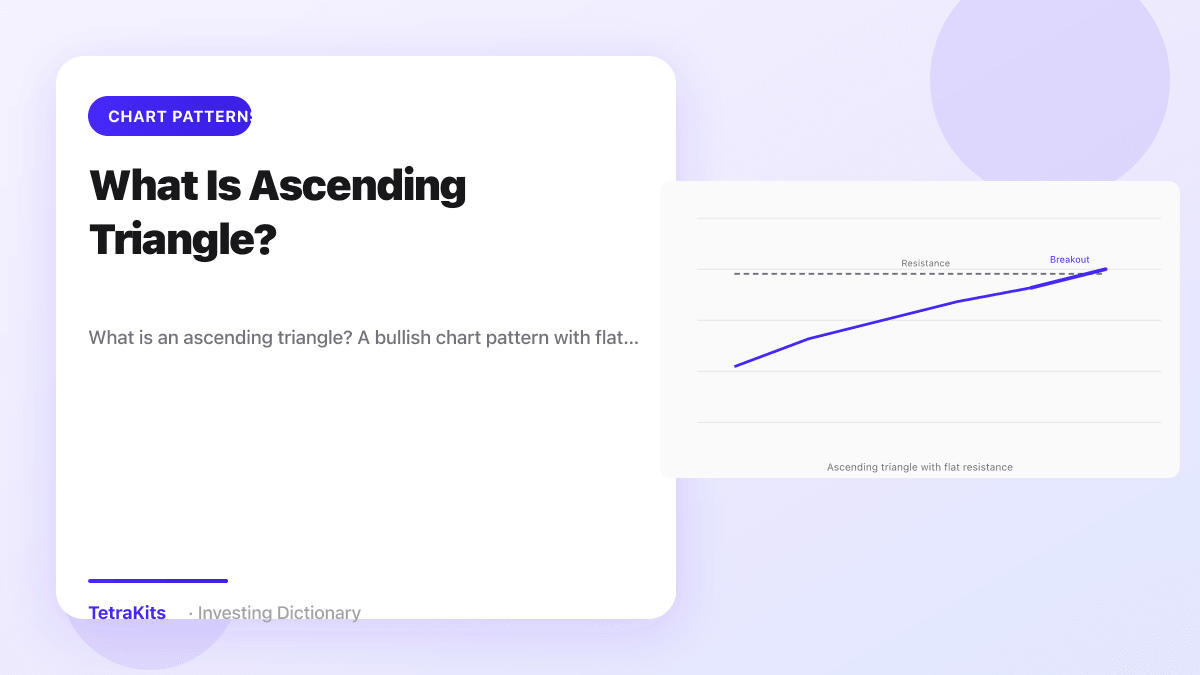
An ascending triangle is a chart pattern defined by flat resistance along the highs and a rising series of higher lows along the lows. Price compresses into a narrowing zone as buyers lift dips more aggressively while sellers defend a ceiling. The formation can act as bullish continuation when it appears mid-trend or as a reversal base when it forms after a decline that is stabilizing. Resolution often comes with an upside breakout above resistance, though failed breaks and whipsaws are common enough that you should read the pattern on a full chart with volume, duration, and a clear invalidation plan rather than as two trendlines alone.
Flat top, rising lows, and spotting real triangles
On a daily or weekly chart, start by drawing a horizontal line across at least two, preferably three, similar highs that cap rallies. Then draw an upward-sloping line connecting higher swing lows. The lower line should rise with purpose: each pullback stops above the prior low, showing demand stepping in sooner. The upper line should stay relatively flat, signaling that supply lingers at a familiar price until it is absorbed or overwhelmed.
Duration and context matter. Triangles that develop over several weeks on equities often carry more weight than cramped shapes on noisy intraday data. Continuation triangles usually sit within an existing uptrend after a pullback. Reversal triangles may appear at the end of a downtrend when lows stop falling and highs begin to flatten against overhead supply. Compare volume inside the pattern: many traders look for lighter volume during consolidation and expansion on breakout attempts.
Contrast with descending triangles, which show flat support and lower highs, often resolving lower on breakdown. Mentioning the bearish cousin prevents bullish bias on every wedge-like shape. Relate ascending triangles to nearby structures: a bull flag can look similar when resistance is slightly down-sloping instead of flat, and a double bottom may underlie the higher lows if the second trough aligns with the rising trendline.
Breakouts, measured moves, and full-chart context
Confirmation for many traders is a close above horizontal resistance with volume above recent average. The breakout day should show commitment: wide range, strong close, and follow-through the next session that holds the broken ceiling as support on a retest. Failed breakouts are routine. Price may poke above resistance, attract late buyers, then slide back inside the triangle. Repeated failures can weaken the pattern until a decisive close clears the level with participation.
Measured move framing helps plan targets. Measure the greatest height inside the triangle from the lowest low to the flat resistance and project that distance upward from the breakout point. If lows near $45 rise toward resistance near $55, a ten-dollar height projects a guide near $65 after clearance. Markets may stall at prior supply or overshoot in momentum regimes. Use the math as a frame, not a promise.
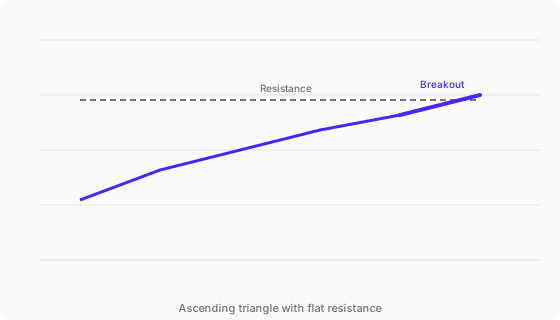
The illustration below shows the ascending triangle on a complete chart with flat resistance, rising support, and breakout path, training you to see compression inside trend context instead of as two lines detached from the timeline.
Failed breakouts, risk, and common mistakes
Stops often sit below the most recent higher low, below the rising trendline, or below the triangle base if price re-enters the pattern after a false break. If the rising support line breaks with conviction, the bullish thesis weakens even if resistance never cleared. Position sizing should reflect distance to the stop and gap risk around earnings or sector news. Some traders enter partial size on the breakout and add on a successful retest of resistance as support.
Relate ascending triangles to reversal and continuation families. At tops, a failed ascending triangle after an extended rally can hand off to a head and shoulders if the right side shows lower momentum into the flat ceiling. After breakout, a shallow bull flag can offer a secondary entry as the new uptrend resumes. Candlestick clues at resistance, such as shooting star rejections before the break, can warn that supply still fights the level.
Common mistakes include drawing flat tops through wick extremes instead of consistent swing highs, labeling every rising wedge as an ascending triangle without a clear ceiling, and chasing vertical breakouts far above resistance where risk-reward collapses. Another error is ignoring the broader market trend: a valid triangle on one stock can fail when the index sells off sharply. Read the full chart, demand volume on the break, place stops under rising support, use measured moves as guides, and respect failed breakouts as signals to stand aside until price proves direction again.
Common questions
Ascending vs descending triangle?
Descending triangles have flat support and lower highs, often bearish on breakdown.