TetraKits
What Is Wyckoff Method?
What is the Wyckoff Method? Composite Man, accumulation and distribution schematics, spring and upthrust with diagram.

The Wyckoff Method is a technical analysis framework developed by Richard Wyckoff in the early twentieth century that studies the relationship between price, volume, and time to infer whether large operators are accumulating or distributing a security. Wyckoff taught that markets are moved by informed interests he called the Composite Man, and that retail traders can read those footprints through trading ranges, tests of support and resistance, and effort-versus-result comparisons on the tape. It is not a single candle pattern but a full-chart approach to supply and demand.
Composite Man, accumulation, and distribution
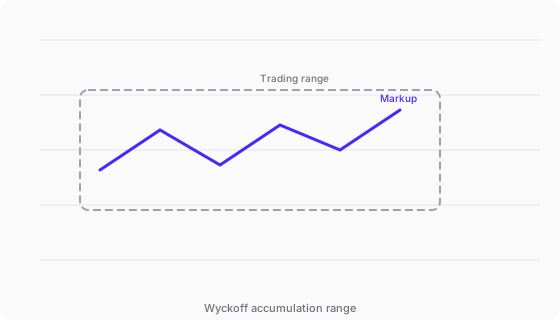
Wyckoff viewed the Composite Man as a collective shorthand for well-capitalized players who accumulate shares quietly during markdown and markup phases, then distribute holdings into strength. Accumulation schematics describe basing after declines: selling climax on wide spread and heavy volume, automatic rally, secondary test of lows on lighter volume, then signs of strength as price lifts toward resistance of the range. Distribution schematics mirror the process at tops: buying climax, upthrusts above resistance, weak rallies on diminishing volume, then signs of weakness as price fails to hold support.
On a real chart, start by identifying a trading range with clear boundaries. Mark prior trend direction leading into the range. Accumulation is suspected after extended weakness; distribution after extended strength. Within the range, label swings and compare each move to volume. Wyckoff emphasized effort versus result: high volume with little price progress suggests absorption or supply overhead, depending on location. Low volume tests suggest supply or demand has thinned.
Phases in Wyckoff schematics (preliminary support, selling climax, creek, jump across the creek, and similar labels) give language for basing processes that can last weeks or months. Perfect textbook sequences are rare. Practitioners adapt labels while keeping the core question: are informed interests likely net buyers or net sellers inside this range?
Spring, upthrust, and volume analysis
A spring is a deliberate probe below support that quickly reverses back into the range, shaking out weak holders before markup. On the chart it looks like a false breakdown: price pierces the range low, then closes back above it, often on a surge of buy volume. Springs are bullish within accumulation contexts. An upthrust is the mirror above resistance: a poke higher that fails to hold, suggesting distribution and potential markdown. Both events are judged by context, not by wick size alone.
Volume validates or undermines the story. A secondary test of lows on lower volume than the selling climax supports accumulation. A breakout from the range on expanding volume supports markup. Weak breakouts that immediately fall back inside the range may be upthrusts rather than true jumps. Compare spread (price range per bar) too: narrowing spread on tests shows reduced urgency; widening spread on breaks shows commitment.
The diagram below maps a Wyckoff accumulation schematic on a full price chart so you can see springs, tests, and range boundaries as part of one narrative instead of isolated bars.
Applying Wyckoff today, risk, and mistakes
Modern traders apply Wyckoff on stocks, ETFs, futures, and liquid crypto pairs with reliable volume. Index products and forex require adaptation because volume is partial or synthetic. Combine Wyckoff ranges with other frameworks when helpful: Dow Theory for trend classification, Elliott Wave for swing structure, or candlestick signals such as a hammer at a spring low. Wyckoff should inform where you look, not replace risk rules.
Stops often sit below the spring low in accumulation trades or above the upthrust high when fading distribution. Because ranges can widen and relabel phases, position size should tolerate shakeouts without abandoning the entire thesis on normal noise. Targets may reference range height projected from the breakout, prior supply zones, or trailing structure as markup unfolds. Patience is part of the method: bases take time, and forcing labels early leads to overtrading.
Common mistakes include calling every false breakdown a spring without volume confirmation, ignoring the preceding trend, and cherry-picking schematic labels to match a bullish or bearish bias. Another error is neglecting effort versus result: a huge volume day that barely moves price means something, but you must read whether it reflects absorption near lows or supply near highs. Wyckoff is subjective and demands practice on full charts. Study Richard Wyckoff's original work, mark ranges honestly, watch springs and upthrusts in context, and let volume tell you whether the Composite Man is more likely buying or selling.
Common questions
Who was Wyckoff?
Richard Wyckoff studied early 20th-century operators and codified their tactics for retail education.