TetraKits
What Is Dow Theory?
What is Dow Theory? Primary and secondary trends, rail averages, and classic market phase framework with illustration.
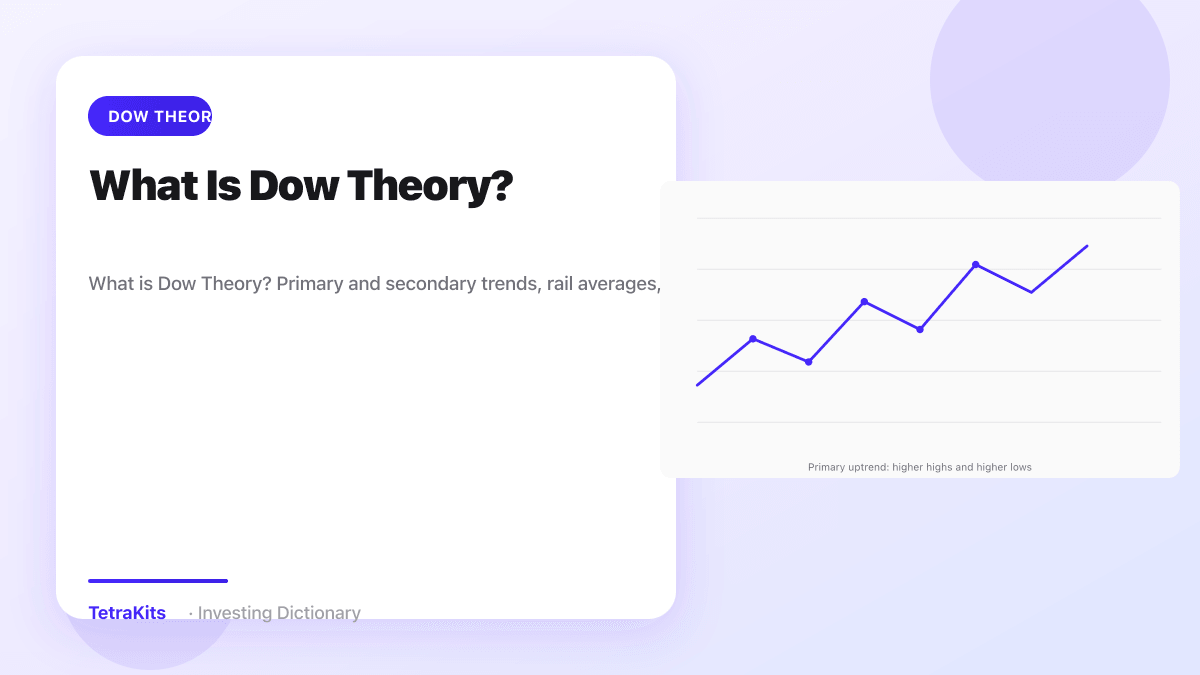
Dow Theory is a framework for understanding market trends based on the work of Charles Dow, co-founder of Dow Jones and The Wall Street Journal, in the late 1800s and early 1900s. It classifies price movement into primary, secondary, and minor trends and emphasizes that major indexes should confirm each other before a trend change is considered reliable. Though markets have evolved, Dow Theory remains a foundation for how many technicians think about bull and bear phases.
Charles Dow and Core Principles
Dow never published a single book titled "Dow Theory." Later writers, including William Peter Hamilton and Robert Rhea, codified ideas from his editorials. Central tenets include the notion that markets discount all available information in price, that trends persist until clear reversal signals appear, and that volume should confirm price movement during healthy trends.
Dow tracked the Industrial Average and the Rail Average, now approximated by the Dow Jones Industrial Average and transportation-related indexes. His insight was that the economy moves as a system: factories produce goods and railroads (today, trucks, airlines, and logistics firms) move them. When both groups advance together, the economic picture looks coherent. When one lags, something may be out of sync.
These principles predate modern sector ETFs and global supply chains, yet the logic of cross-group confirmation still appears in macro research. Analysts compare tech leaders to semiconductors, or credit spreads to equities, searching for the same kind of agreement or divergence Dow described.
Primary, Secondary, and Minor Trends
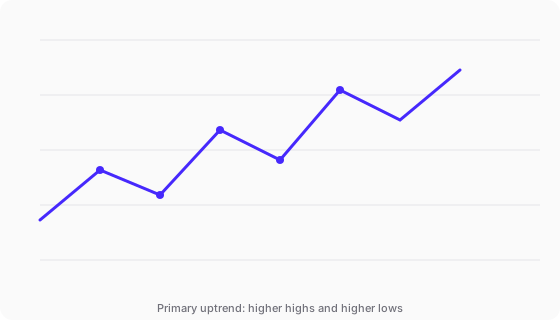
Primary trends last years and define bull or bear markets. A primary uptrend shows a series of higher highs and higher lows on monthly or weekly charts. Primary downtrends do the opposite. Investors with multi-year horizons care most about this degree because it frames strategic asset allocation.
Secondary trends are counter-moves within the primary trend, often lasting weeks to months. A bull market pulls back 5 to 15 percent in a correction before resuming. Dow Theory treats these as normal digestion, not necessarily trend reversals. Distinguishing a secondary reaction from a primary reversal is where experience and confirmation rules matter.
Minor trends span days and matter mainly to short-term traders. Noise at this scale can contradict the larger picture. Dow Theory advises against letting minor swings override primary classification unless evidence accumulates at higher degrees.
Confirmation and Non-Confirmation
Confirmation means two related averages reach new highs together in an uptrend or new lows together in a downtrend. Non-confirmation occurs when one index makes a new high but the partner fails to follow. Dow considered that a warning that the primary trend might be weakening, though not an automatic sell signal.
Modern practitioners adapt the idea. Transports failing to confirm industrials at a market peak receives periodic attention in financial media. Sector rotation can produce temporary non-confirmation without a full bear market. Context from breadth indicators, new highs versus new lows, and credit conditions adds nuance Dow's era lacked.
Volume confirmation suggests participation: rising prices on expanding volume imply broad demand; rising prices on shrinking volume raises questions about sustainability. The exact volume data available today is richer than in Dow's time, but the effort-versus-result logic survives in tools like the Wyckoff Method.
Is Dow Theory Still Relevant?
Critics note that the U.S. economy is more service-oriented and technology-driven than in the railroad era. The Dow Industrials includes only 30 stocks, while the S&P 500 better represents broad equity exposure. Some Dow rules feel subjective when applied to fast, algorithmic markets.
Supporters reply that Dow Theory was never a precision timing system. Its value lies in trend classification, patience during secondary reactions, and skepticism when indexes diverge. Those habits remain useful when social media amplifies every daily wiggle into a crisis or a mania.
Related frameworks like Elliott Wave Theory label swings differently but also stress multi-degree analysis. Dow Theory offers a simpler entry point: identify the primary trend, expect corrections, demand confirmation before calling a reversal. For investors building a mental map of market cycles, that structure still earns its place in the technical analysis canon more than a century after Charles Dow first wrote about it.
Common questions
Is Dow Theory still used?
Yes, especially for trend classification and index confirmation concepts.