TetraKits
What Is Bollinger Bands?
What are Bollinger Bands? Volatility channels around a moving average used to spot overextension and potential mean reversion.
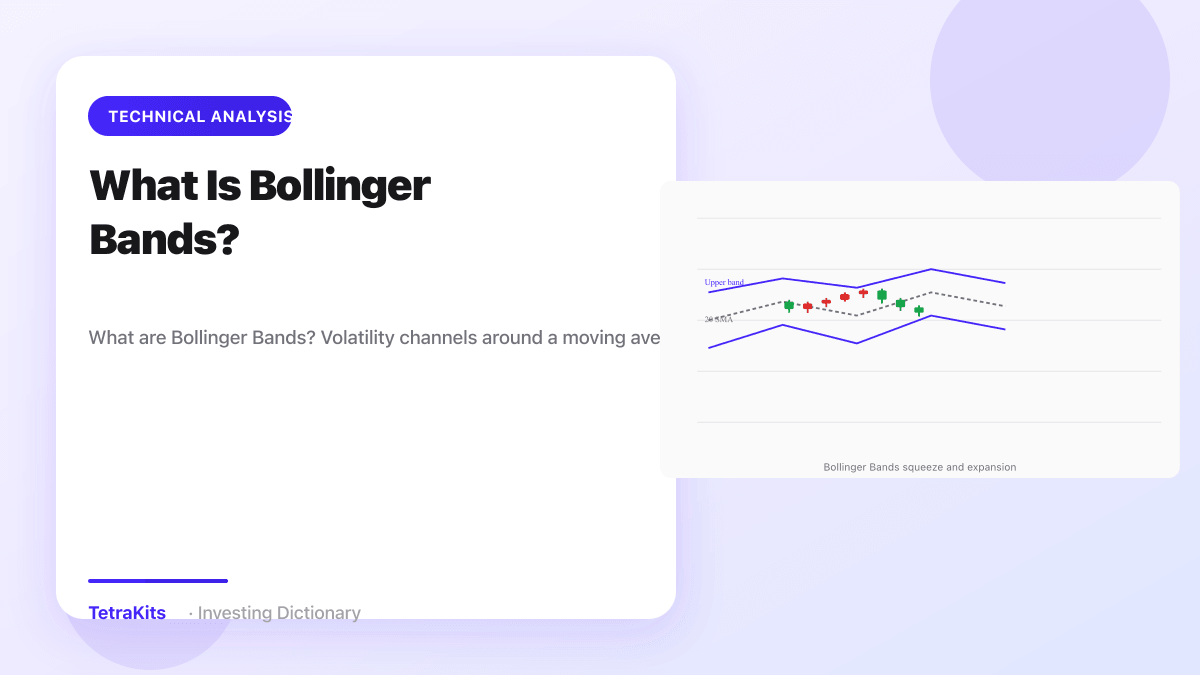
Bollinger Bands are a volatility indicator built around a simple moving average. John Bollinger popularized the tool in the 1980s to show when price had moved unusually far from its recent mean. The middle band is typically a 20-period SMA. Upper and lower bands sit a set number of standard deviations above and below that average, creating a channel that expands and contracts with market volatility.
How Bollinger Bands Are Built
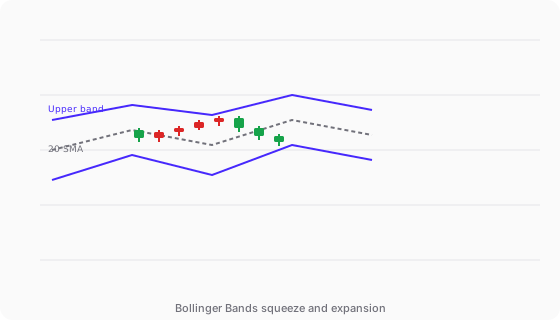
Standard settings use 20 periods and 2 standard deviations on daily charts, though you can adjust both. When volatility rises, the bands widen because recent closes spread farther from the average. When markets go quiet, bands squeeze together, signaling compressed volatility that sometimes precedes a larger move, though direction is not implied by the squeeze alone.
Standard deviation measures dispersion around the mean. Roughly 95 percent of closes in a normal distribution would fall within two standard deviations, but financial returns have fat tails, so price can ride the upper or lower band for extended stretches during strong trends. Touching the upper band is not automatically overbought in the same way RSI above 70 might suggest.
The middle band acts like any other moving average: support in uptrends, resistance in downtrends. Many traders watch whether price walks the upper band during momentum phases or repeatedly reverts to the middle line during range-bound conditions.
Reading the Bands on a Chart
In a steady uptrend, price may hug the upper band while the middle band slopes higher. Selling solely because price touched the upper band often means exiting a healthy trend too early. In a range, moves from upper to lower band fit mean-reversion thinking: buy weakness near the lower band, sell strength near the upper band, with stops outside the channel if the range breaks.
Band width offers a separate signal. A narrow band period, sometimes called a Bollinger squeeze, highlights low volatility. Traders prepare for a breakout but still need confirmation from price direction and volume. A squeeze does not tell you whether the breakout will be bullish or bearish.
Pair bands with RSI or MACD when looking for divergences near band extremes. Price making a new high at the upper band while RSI weakens warns that the extension may not last, even if the band itself has not signaled a turn yet.
Band Walks and Failed Signals
A band walk occurs when price closes near the upper or lower band for many sessions in a row. It reflects sustained momentum rather than immediate reversal. Mean-reversion traders who fade every upper-band touch lose money during these phases unless they use tight risk rules and accept frequent small losses.
False signals appear when news gaps price outside the bands overnight. The bands recalculate on the next bar, but the fundamental event may justify a new trading range entirely. Treat extreme prints after earnings or macro shocks as context shifts, not automatic fade setups.
Multiple time frame analysis helps. A lower-band touch on a daily chart inside a weekly uptrend differs from the same touch in a confirmed downtrend. Always zoom out before you interpret a single band tag as a trading edge.
Practical Limits of Bollinger Bands
Bollinger Bands describe recent volatility relative to a moving average. They do not incorporate volume, earnings, or order book depth. Backtests on band touches alone rarely survive transaction costs without additional filters for trend, time of day, or sector strength.
Changing the standard deviation multiplier changes behavior dramatically. Tighter bands produce more signals with more noise; wider bands produce fewer, more extreme tags. Optimize on past data with care to avoid curve fitting that fails live.
Used with discipline, Bollinger Bands help you see when price is stretched versus its recent norm. Used as automatic buy and sell buttons, they frustrate. Treat the channel as one volatility lens in a broader toolkit that includes price structure, risk limits, and the macro backdrop driving the asset you trade.
Common questions
Default settings?
John Bollinger popularized 20 periods and 2 standard deviations on daily charts.