TetraKits
What Is RSI?
What is RSI (Relative Strength Index)? Momentum oscillator definition, overbought/oversold levels, and limits.
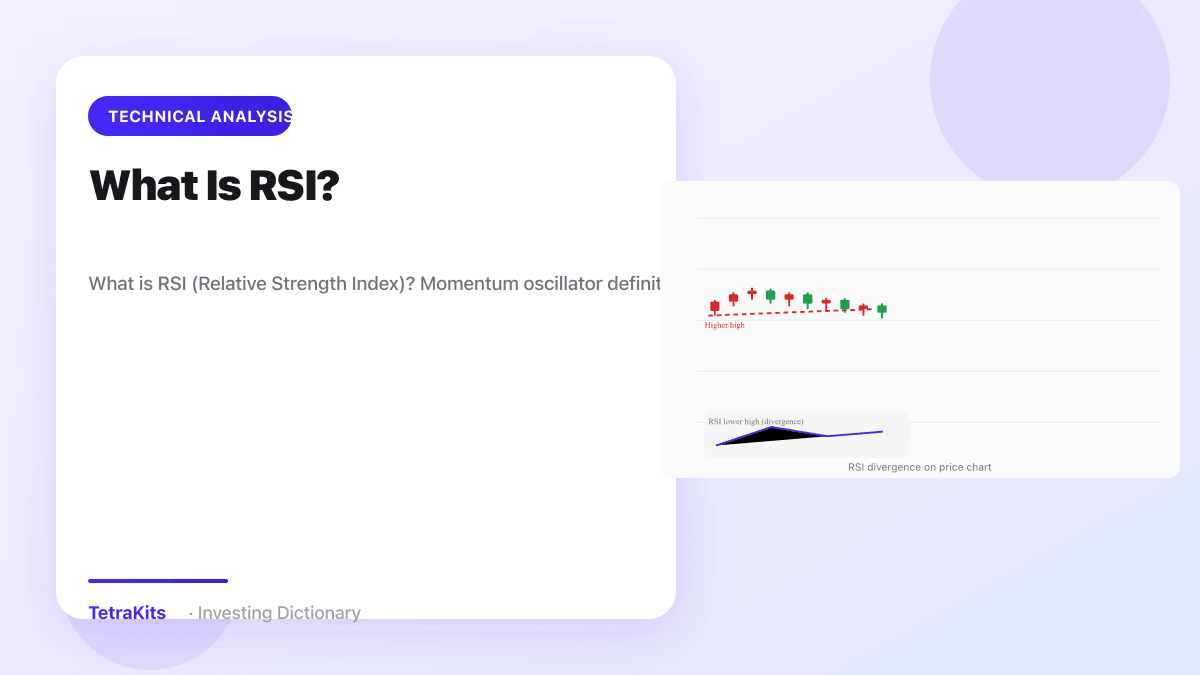
The Relative Strength Index (RSI) is a momentum oscillator that measures how quickly and strongly price has moved over a recent lookback period. Developed by J. Welles Wilder, it plots on a scale from 0 to 100 and helps traders gauge whether recent gains or losses have pushed a market toward stretched conditions. RSI does not predict direction by itself, but it highlights when momentum may be tiring or when divergences warn of a shift.
How RSI Is Calculated
RSI compares average gains to average losses over a set number of periods, most commonly 14 on daily charts. Wilder's smoothing method weights recent data while carrying forward prior averages, which makes the line less jumpy than a simple average would be. The formula converts the ratio of average gain to average loss into an index bounded between zero and one hundred.
When every day in the window closes higher, RSI approaches 100. When every day closes lower, it nears 0. Most of the time, readings cluster in the middle band as markets chop. Changing the lookback period changes sensitivity: a 7-period RSI reacts faster; a 21-period RSI smooths out noise but lags turning points.
RSI works on any time frame, from one-minute scalping charts to weekly position trading. The interpretation stays similar, though intraday readings whipsaw more often. Always align the period with your holding horizon rather than copying defaults blindly.
Overbought, Oversold, and Chart Context
Classic teaching marks RSI above 70 as overbought and below 30 as oversold. In practice, strong trends can keep RSI elevated for weeks. A stock in a bull run might hold between 60 and 80 without meaningful pullbacks, so selling solely because RSI crossed 70 often means leaving money on the table.
Oversold readings below 30 appear more reliably at the end of sharp selloffs, but they do not guarantee an immediate bounce. Bear markets can print repeated oversold signals while price keeps making lower lows. Context from trend, support levels, and volume matters more than the number alone.
Many traders treat RSI as a filter rather than a trigger. They might look for long setups when RSI dips toward 40 in an uptrend, or wait for a bearish divergence before reducing exposure near highs. Pairing RSI with price structure beats treating 70 and 30 as automatic sell and buy buttons.
Divergence and Trending Markets
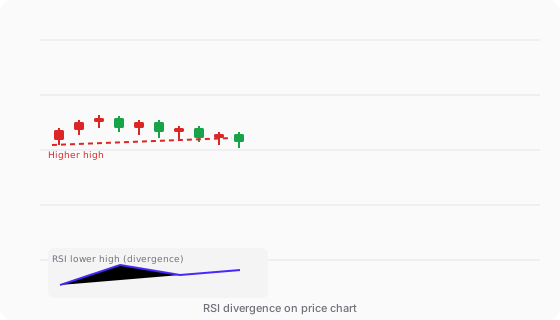
Bullish divergence occurs when price makes a lower low but RSI makes a higher low, suggesting selling pressure is weakening even though price has not turned yet. Bearish divergence is the mirror: price makes a higher high while RSI makes a lower high, hinting that gains are losing steam. Divergence often precedes reversals but can persist for many bars in strong trends, so confirmation from price action remains essential.
Hidden divergence appears in continuation setups. In an uptrend, price pulls back to a higher low while RSI dips to a lower low, sometimes signaling trend resumption. Learning both regular and hidden forms takes screen time, and not every divergence resolves cleanly.
In choppy, range-bound markets, RSI mean reversion strategies perform better. In trending markets, momentum tools like MACD sometimes align more naturally with the dominant move. Switching indicators without adjusting expectations leads to frustration.
Practical Limits of RSI
RSI is derived entirely from price. It ignores volume, fundamentals, and news flow. Gap moves can skew averages abruptly. Low-float stocks with violent squeezes produce extreme readings that reflect microstructure more than sustainable momentum.
Backtests on RSI signals alone often show mediocre results after costs, which is why professionals combine oscillators with trend lines, moving averages, and risk management. A single reading on a doji day at resistance tells a richer story than RSI in isolation.
RSI remains popular because it is simple, bounded, and widely available on every charting platform. Used with discipline, it helps you ask better questions about whether a move is extended. Used as a magic threshold, it generates false confidence. Treat it as one lens in a broader technical toolkit, not a standalone oracle.
Common questions
Best RSI period?
14 is default; shorter periods react faster, longer are smoother.