TetraKits
What Is Bearish Engulfing?
What is a bearish engulfing pattern? A two-candle reversal where a large red body swallows the prior green body after an uptrend.
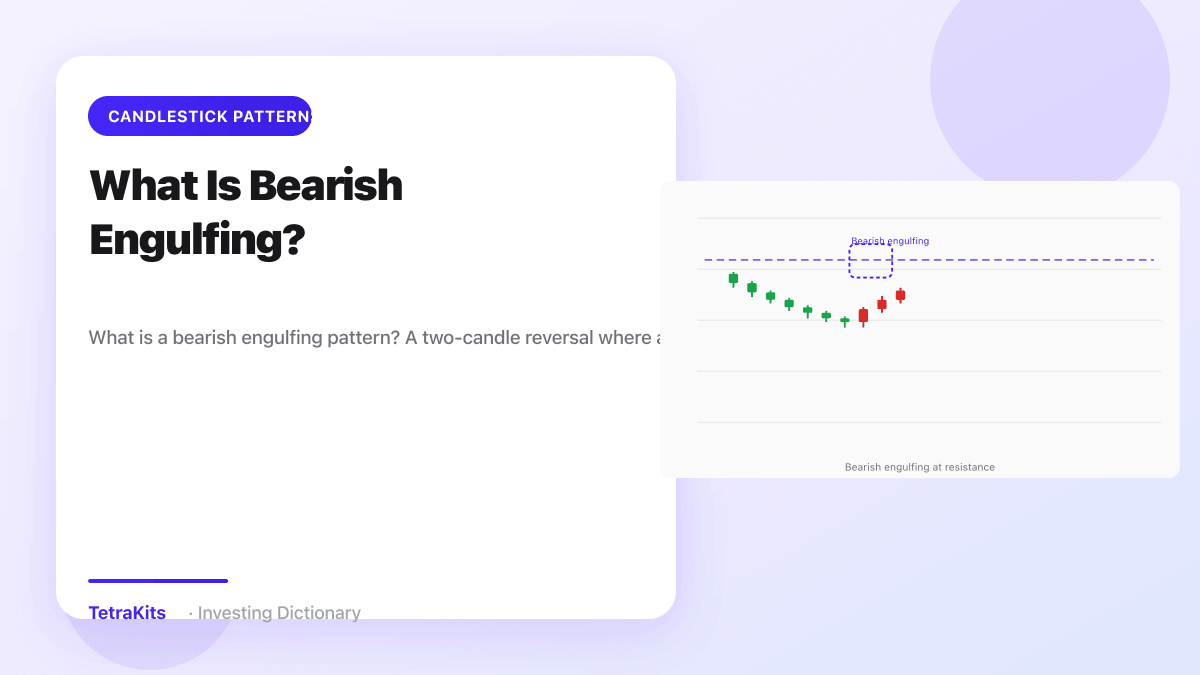
A bearish engulfing pattern is a two-candle reversal formation where a small bullish candle is followed by a larger bearish candle whose real body completely covers the prior body. The second session opens at or above the previous close and finishes below the previous open, signaling that sellers absorbed buying pressure and closed with control. Like every candlestick signal, it matters most when you read it on a full chart after a rally, ideally near resistance, with volume and follow-through that confirm the shift.
Body engulfing rules and what counts
Classic definitions focus on real bodies, not wicks. The red body of day two must span from above the green body high to below the green body low. Wick overlap is secondary; some strict traders want the second candle to engulf the full range, but most educators emphasize bodies because opens and closes carry the clearest statement of who won the session. Day one should reflect ongoing strength: a modest green candle in an uptrend fits well. Day two should be wide and decisive relative to recent bars.
Zoom out before you label the pattern. A bearish engulfing in a sideways range is often just noise. A bearish engulfing after five to ten green sessions, printing at a prior swing high or moving average, carries a different message. Check the size of the engulfing candle against the average true range of the last month. A truly large red bar suggests aggressive selling, not a random dip. Compare volume: expansion on the engulfing day supports the idea that new supply arrived.
Contrast with bullish engulfing, the mirror version at bottoms. There, a small red day is followed by a larger green day whose body swallows the prior red body. Mentioning the bullish variant helps you avoid bearish bias. If you see bullish engulfing at support after a decline, respect the symmetry of the market: the same two-candle logic that marks tops can mark bottoms when context flips.
Spotting bearish engulfing on real charts
On a daily chart, scroll to a clear rally within a longer downtrend recovery or an extended advance in a bull market that has stretched sentiment. Mark resistance where price rejected before. When the engulfing pair appears with its high holding that zone, note whether the pattern high gives you a clean stop reference. Traders often enter on the close of the engulfing candle or on a break below its low the next session. Both approaches seek confirmation that sellers are still present after the initial surge.
Look at the candles surrounding the pair. A doji or small-bodied bar before the engulfing day can show indecision that resolves bearishly. A shooting star two days earlier plus an engulfing finish can form a micro top story. After the engulfing, watch for bounces that fail below the pattern midpoint or below the engulfing high; shallow retests often keep the reversal thesis alive.
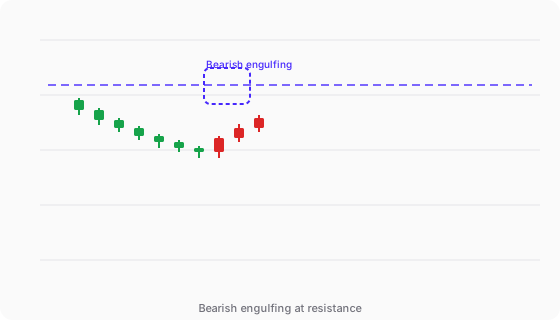
The chart illustration below shows the two-candle handoff inside an uptrend and near a resistance shelf, which is how you should train your eye: pattern plus location plus room below before you plan a trade.
Confirmation, stops, and common mistakes
Engulfing patterns lag slightly because you must wait for the second close. That delay is a feature: it filters impulsive entries on single wicks. Confirmation can include a third red day, a break of a short-term ascending trendline, or RSI curling down from overbought without predicting the turn by itself. If price immediately reverses and closes above the engulfing high, treat the signal as failed and stand aside.
Stops typically sit above the engulfing pattern high or above resistance that framed the setup. Gap risk matters for overnight holds: earnings or macro news can skip through your stop. Size accordingly. Targets may aim at the nearest demand zone, a prior breakout level now acting as support, or a fixed risk-multiple if you run a systematic plan.
Common mistakes include chasing bearish engulfing candles that print far below resistance after a vertical selloff, ignoring the primary trend in a strong bull market, and requiring wick engulfing when only the body qualified. Another error is swapping time frames: an engulfing on a weekly chart is a major event; on a one-minute chart it may appear dozens of times per session. Read the full chart, demand location and volume, define risk above the pattern, and remember that bullish engulfing at support uses the same logic in reverse.
Common questions
Bearish vs bullish engulfing?
Bearish appears after uptrends at resistance. Bullish appears after downtrends at support.